

I used to be the perpetually distracted guy—the one who’d check email before breakfast, start five projects before lunch, and end up doomscrolling social media when I needed to be working. Not exactly the image of a hyper-focused CEO, right? The turning point: the day I realized the best in the world weren’t muscling through distractions—they were hacking their brains. If you’re sick of losing battles with your own mind (or just want a few unfair focus advantages), you’re in the right place. Here’s what actually worked for me (and no, it’s not just about bullet journaling or lighting candles).
1. The Anti-Todo Revolution: Why Cutting Out Tasks (and Toxic People) Is the Start of Real Focus
Let’s flip the script on productivity. If you’re like me—ADHD, easily distracted, and tired of fighting your brain—here’s the truth: the most productive people don’t muscle their way through endless to-do lists. They use ADHD productivity hacks that start with subtraction, not addition. The first and most powerful hack? Creating a Not-To-Do List.
Why a Not-To-Do List Beats a To-Do List
Focus isn’t a muscle you build by piling on more tasks. Focus is a filter. The more you cut, the clearer your path. Every new “yes” is a “no” to your dreams. I live by this:
"You don't do more to win, you do less, but you make the things you say no to, the right yeses."
The Plinko Effect: Visualizing Your Energy
Picture the game Plinko: you drop a ball, and it bounces off dozens of pins, landing somewhere random. That’s how most people live—scattering energy across distractions. But if you remove those pins (distractions, tasks, toxic people), your energy shoots straight to what matters. Prioritizing tasks becomes effortless when you subtract the noise.
What Goes on My Not-To-Do List?
- Low-value tasks: If I can pay someone else or automate it, it’s gone. Outsourcing and routine elimination are game-changers.
- Bad habits and vices: For me, late-night gaming was a killer. I’d stay up, then drag through the next day. Cutting it out gave me back hours of focus.
- Energy vampires: Some people (and activities) drain your creative energy. If someone leaves you feeling depleted, they’re off my calendar.
Research backs this up: Subtracting just 3-5 persistent distractions can increase your daily focused time by up to two hours. Eliminating energy vampires and time-wasters isn’t just about productivity—it’s about protecting your mental bandwidth.
Saying No Is a Skill
Here’s my unpopular opinion: saying no is the real productivity superpower. It’s not easy, but your focus depends on it. Every “no” to a low-value task or toxic person is a “yes” to your biggest goals. Start your own not-to-do list today, and watch your focus sharpen.
2. Tricking Your Brain into Flow: Rituals, Environments, and Built-In Triggers
Here’s the truth: focus isn’t a muscle you flex—it’s a filter you set. If you’re like me (a former scatterbrain CEO), waiting for inspiration to strike is a recipe for endless distraction. Instead, I learned to create focus triggers—deliberate cues that help me slip into Finding Your Flow on demand. As I always say,
"See, flow state isn't random, it's designed."
My Unexpected Toolkit for Deep Work Blocks
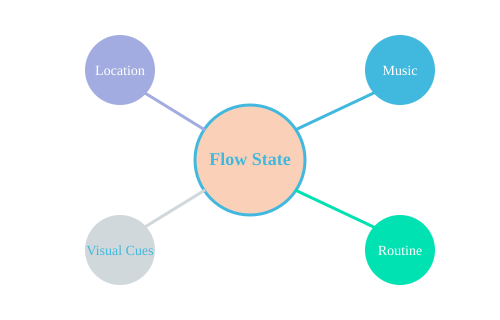
- Location: I have a specific chair for reading and brainstorming. When I sit there, my brain knows it’s time for Deep Work Blocks. Even quarterly planning offsites with my wife have become rituals—those locations are triggers for designing our future, not worrying about the day-to-day.
- Sound: Headphones are my armor. I use playlists with no lyrics or binaural beats (yes, the science-y stuff!) to anchor my attention. The ‘focus playlist’ experiment? For me, binaural beats + headphones = productivity magic.
- Routine: If it’s not in my calendar, it doesn’t exist. I block 60–120 minute sessions—my prime time for deep work. World-class athletes rehearse routines before every game. Why shouldn’t we? My mornings start with the same sequence: coffee, headphones, and a closed door. That’s my signal to my brain: it’s go time.
- Visual Cues: A closed door, a ‘do not disturb’ sign, or just visible headphones signal to others (and myself) that I’m in a Building Distraction-Free Environment.
Personal Routines for Focus: Why Routine Isn’t Boring
People think routine is dull. But you know what’s really boring? Never finishing anything because you’re constantly distracted. Routine is the rhythm of success. Research backs this up: establishing three or more unique focus triggers (location, sound, routine, visual cues) correlates with higher self-reported productivity.
Multiple sensory cues—where you sit, what you hear, and what you do—prime your brain for flow. My advice: design your environment so that deep work becomes automatic. Don’t wait for focus to find you. Build your own triggers and watch your productivity soar.
3. Build Your Focus Fortress: How to Be (Strategically) Hard to Reach and Manage Distractions
Let me take you back to the most productive week of my life: editing my book in a WiFi-free mountain cabin with my friend Chris. No notifications, no inbox, no distractions—just 16 hours a day of deep work, for five days straight. We finished the book. That experience taught me the power of building a true distraction-free environment and being intentionally hard to reach.
Be Accessible Online, But Hard to Interrupt Personally
Here’s the truth: most of us make it way too easy for others to interrupt us. The constant ping of notifications, the endless stream of emails—these are productivity killers. I live by this rule: be easy to find online, but hard to reach in real time. My phone only allows notifications from two people: my wife and my assistant. Everyone else can wait.
- Turn off all notifications. Go into your app settings and swipe them off. Seriously, try it. You’ll be amazed at how much mental space you reclaim.
- Restrict channels of interruption. The fewer ways people can reach you instantly, the more deep work you’ll get done.
Batch Your Communications for Maximum Focus
Your inbox? It’s just a “
Your inbox is nothing more than a public to-do list of other people's priorities on your time.” Instead of letting it dictate your day, batch your responses. I schedule dedicated 60-minute windows to reply to texts and emails—sometimes while relaxing in the hot tub. This is a powerful time management technique that turns communication from a distraction into a productivity tool.
Use Visual Signals and Environmental Cues
- Headphones = Do Not Disturb. When I put on my headphones, everyone knows not to interrupt unless it’s urgent.
- Closed door rules. My family knows that a closed office door means “focus mode”—unless it’s an emergency, they wait.
Change Your Environment to Suppress Interruptions
Sometimes, the best way to manage distractions is to physically remove yourself. Work from a coffee shop or another quiet space. Here’s an advanced move: leave your power cable at home. With only your laptop battery, you’ll be forced to focus and finish before the juice runs out.
Managing distractions isn’t about willpower—it’s about building systems and environments that protect your focus. Try these strategies and watch your productivity soar.
4. Turn Up the Pressure—But on Your Own Terms: Using Urgency and Gamification to Outwit Your Inner Procrastinator
If you have ADHD (or just a wandering mind), you know how easy it is to let tasks stretch out forever. Here’s the truth: Parkinson’s Law Productivity is real. As the saying goes,
"There's this thing called Parkinson's law that states the work will expand to the available time given to it."If you give yourself three months to move out, you’ll pack slowly, get distracted, and procrastinate. But if you only have three days? Suddenly, you’re laser-focused and unstoppable. That’s the power of a Sense of Urgency.
Shorten the Timeline, Raise the Stakes
Artificial deadlines are my secret weapon. When my team says, “I’ll get it to you by the end of the week,” I push back: “Why not by 3 p.m.?” Shorter timelines force creativity and focus. But urgency alone isn’t enough—you need real consequences. I once had a team member, Jen, who wanted to lose weight. She made it public, and we set a non-negotiable: if she didn’t hit her goal by the deadline, her job was on the line. The stakes were real, and her focus followed.
Gamifying Work Motivation: Make Progress Visible
Here’s another ADHD Productivity Hack: Gamify your work. Video games are addictive because you see your progress—levels, streaks, XP bars. I track my writing sessions like XP points. Every finished draft is a “level up.” When you can see your progress, you’re less likely to get bored or distracted. Immediate Rewards—like checking off a to-do, hitting a streak, or moving a progress bar—keep your dopamine (and motivation) high.
- Break big tasks into “levels” or milestones
- Track streaks for daily habits
- Use visible progress bars or checklists
- Celebrate small wins—don’t wait for the finish line
Research shows time constraints enhance focus and creativity. Gamification increases dopamine and keeps you motivated. If you can’t see your progress, your brain gets bored and wanders. Design visible, trackable wins to keep your attention locked in.
| Data Point | Insight |
|---|---|
| Refocus time after distraction | 23 minutes average (per research) |
| Public commitment to team | Job at stake for missing goal |
| Gamified work | Adding 'levels' increases task completion rates |
Conclusion: Not-So-Obvious Truths About Focus—And the Real Source of Productivity
If you’ve made it this far, you already know this isn’t your typical list of ADHD productivity hacks or generic focus strategies for ADHD. Here’s the not-so-obvious truth: Stop trying to brute force yourself into focus. The real game-changer isn’t more willpower—it’s about hacking your context and environment until they work for you, not against you.
For years, I thought my problem was distraction. I’d blame boredom or lack of discipline. But the real reason I drifted off task? I couldn’t see my progress. When you can’t see the finish line (or even the next step), your brain goes hunting for something easier, shinier, or just less frustrating. That’s why managing distractions is less about ironclad self-control and more about making your progress visible and your environment frictionless.
Here’s what actually works: Success is a subtractive game. Most of us try to add more—more apps, more routines, more rules. But the magic happens when you start cutting out what doesn’t serve you. For example, I bought a new chair just for my “hard tasks.” Now, it’s the only spot I write from. No emails, no scrolling—just deep work. It’s a tiny shift in context, but it’s changed everything about my workflow. That chair is my productivity hack, and it’s weirdly sacred now.
Perfection is a myth, especially with ADHD. The real win is consistently showing up and stacking small victories. Some days, that means writing one paragraph. Other days, it’s just opening the document. What matters is the ritual, not the outcome. Experiment with your rituals—personalize, tinker, and keep what works (and toss the rest). If something feels forced or makes you miserable, ditch it. Your best focus strategies for ADHD are the ones you invent for yourself.
And let’s not forget: saying “no” is a radical productivity strategy. Seriously. Every time you cut out a commitment, a distraction, or a tool that doesn’t fit, you’re making space for what matters. That’s the real source of productivity—not more effort, but better choices. So, stop chasing focus and start designing your environment. Your brain (and your to-do list) will thank you.